Your Ideas Don't Matter
And your attachment to them holds you back.

Early in my career, a huge influencer ripped off one of my ideas. His blog post got 100 times as many likes as shares as mine did. Everyone in my industry hailed him as a genius. I was so upset that I nearly gave up.
Now I look back and realize none of it even mattered.
Ideas are a weird thing in that they feel so uniquely special and valuable because they only seem scarce to us. Whatever idea we have that we love, it’s the only idea version of that idea that we’ve had, so we get emotionally attached to it.
But the world, the broader market, has likely had versions of that idea 100,000 times. And thousands of those people are already out there executing on it. There is nothing actually scarce about the idea. In fact, the idea, in and of itself, has almost zero value.
It’s only the implementation of the idea that has any value.
And even if someone else’s implementation of the idea succeeds, that doesn’t mean that your implementation can’t succeed even more. And sure enough, when you look at all of the most successful creations in the world, pretty much all of them are a knock-off in some shape or form.
Oreo cookies ripped off another cream-filled cookie called “Hydrox” invented four years prior. Oreo got the distribution, and now it sells 92 million units artificial chocolate delight every day.
Google was, like, the sixteenth search engine invented. At the time it started, AltaVista was king. Chances are if you’re under 35 years old, you haven’t even heard of AltaVista.
Barbie is based on a German adult novelty doll sold in bars. Mattel paid $21,600 for the rights. Now 100 Barbies are sold every minute.

I can go on and on with these examples. Star Wars ripped off Joseph Campbell’s “Monomyth” idea and just put it in space. Disney’s The Lion King ripped off a 1960s Japanese Anime called “Kimba, the White Lion.” Led Zeppelin famously ripped off a number of obscure blues and folk artists from the 1950s. Michael Jackson’s “Billie Jean” lifted its famous bass line directly from a Hall & Oates song.
The point is: there is no such thing as a new idea. Every idea has been done, and 10 other people are already doing new versions of it.
What is unique and special is the implementation of the idea. The long-term winners win because their version—their specific personality, perspective, and execution—made the original irrelevant.
I spent years mourning ideas that "got taken."
The whole time, the only thing that actually mattered was making my version so distinctly mine that nobody would think to compare.
Because it turns out, the research on creativity shows that nothing is actually created. Everything is remixed, rearranged, reimagined, recombined into something that looks unique and original, even if it’s not. You take the pieces apart and put them back together in a new way. Or just combine the idea with some other disparate idea no one else had ever considered before.
That is actually what creativity is.
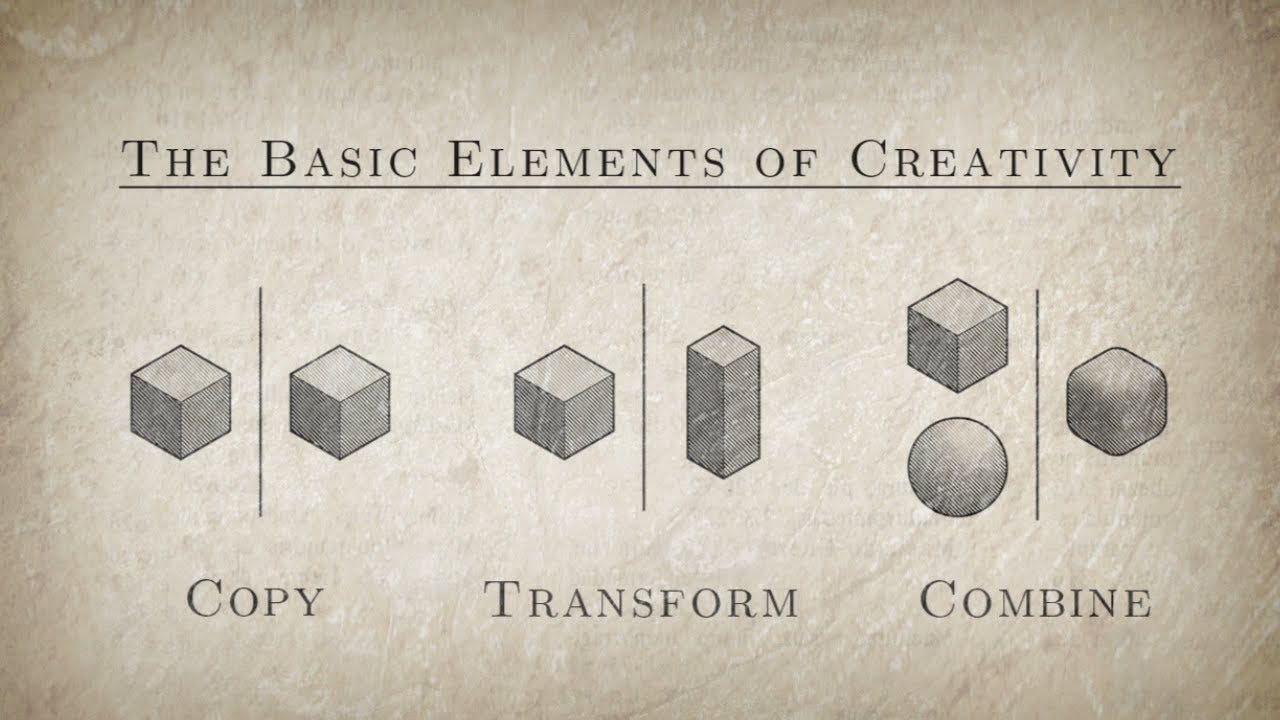
I’ve built a career giving people life advice. But none of that life advice is original. It’s just regurgitating the timeless wisdom of the Buddha, the Stoics and the existentialists in some new way. It’s repackaging academic psychological research and explaining it in a way people enjoy and find applicable.
And ironically, those are the ideas that are unique and creative and valuable—the packaging, not the advice.
It’s why I’m still here with an audience of millions and that guy who ripped me off in 2008 has probably had a day job for over a decade now.
But I definitely didn’t feel like that at the time.
I remember that night, I was so upset that I called my dad.
My dad’s career is about as far from my career as you could possibly get. He’s an engineer. He works in industrial manufacturing. He makes plastic widgets for a living.
But he’s also an entrepreneur and business-owner and I thought he might have some legal advice or something.
I told him what had happened and immediately he started chuckling, “Oh man, I’ve been there. Just move on. Just write your next piece.”
“What?” I said, totally surprised. “I don’t understand.”
He proceeded to rattle off multiple stories off the top of his head. The patent lawsuit he filed in the mid-80s… and lost. The time one of his salesmen was secretly selling spec sheets to one of his competitors. Or the time a much larger company he had signed a non-compete deal with secretly spun up a new corporate entity so that they could actually legally compete with him, stealing his customers.
On and on it went. He seemed amused by the whole thing. “That’s business,” he said. “That’s life, really.”
“But, what did you do?” I asked. “Did you fight back?”
Then he gave me some of the most useful advice anyone has ever given me.
He said, “Look Mark, there are two ways to succeed in this world. You can either spend your life looking for golden eggs and fighting over them. Or you can learn how to become a goose who lays golden eggs. If you become the goose, you’ll never worry about anyone ‘stealing’ anything from you again.”
Wasn’t German Barbie called Brunhilda? (Just joking!)Actually she is peculiarly unsettling. And I always thought Hydrox was better than Oreo. Again, a better name. Great essay Mark! I think I’ll use your idea for my next blog.
Thanks mark , So now I have to find a gander to impregnate me